



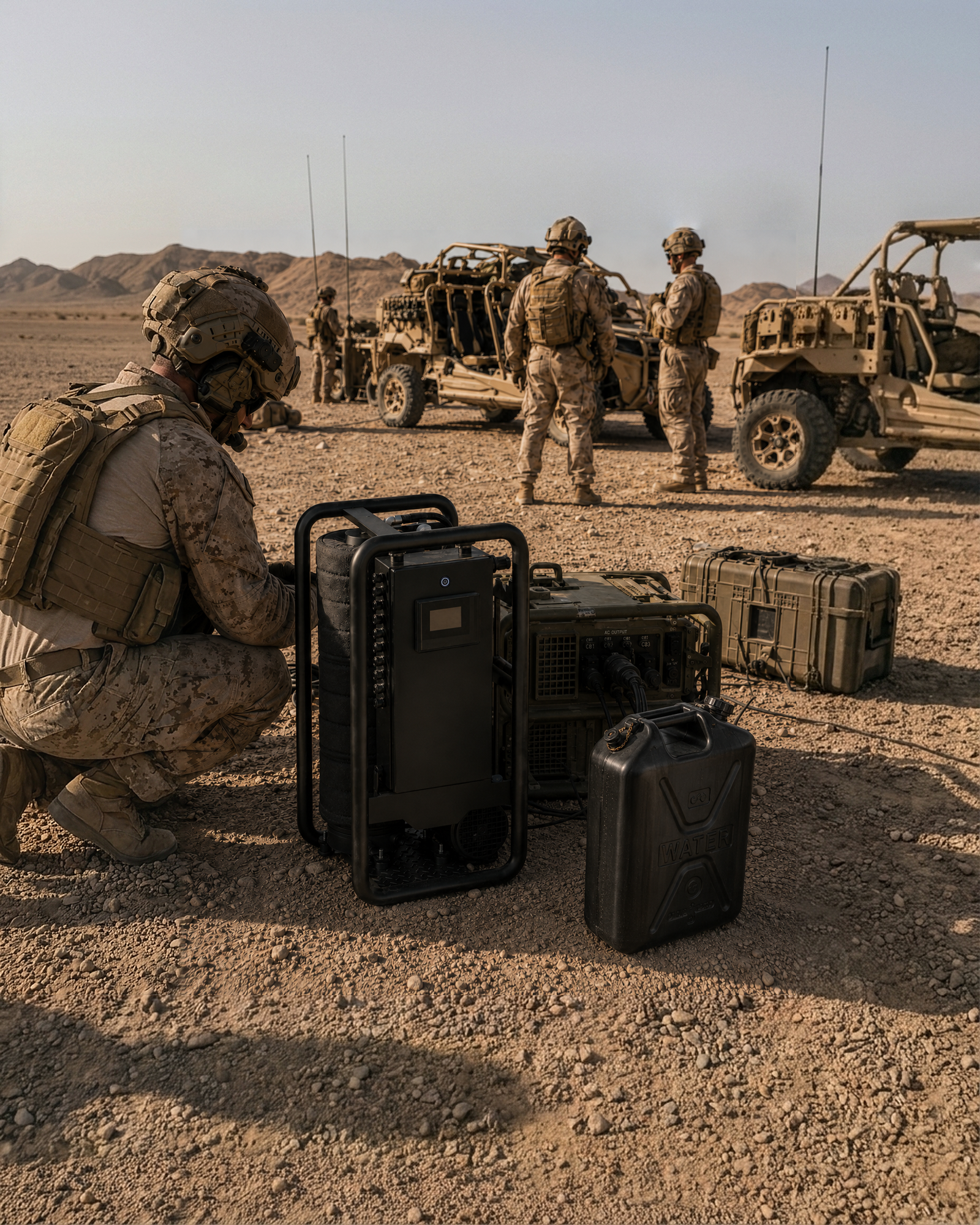

Water self-sufficiency has arrived
Up to 216 litres of clean water a day. No resupply runs. The UK-built M1 makes safe drinking water from seawater, rivers or floods. No filters, membranes or chemicals to resupply.
Miniaturised desalination
No consumable parts
Total microbial removal
Vehicle mountable, 2 person lift
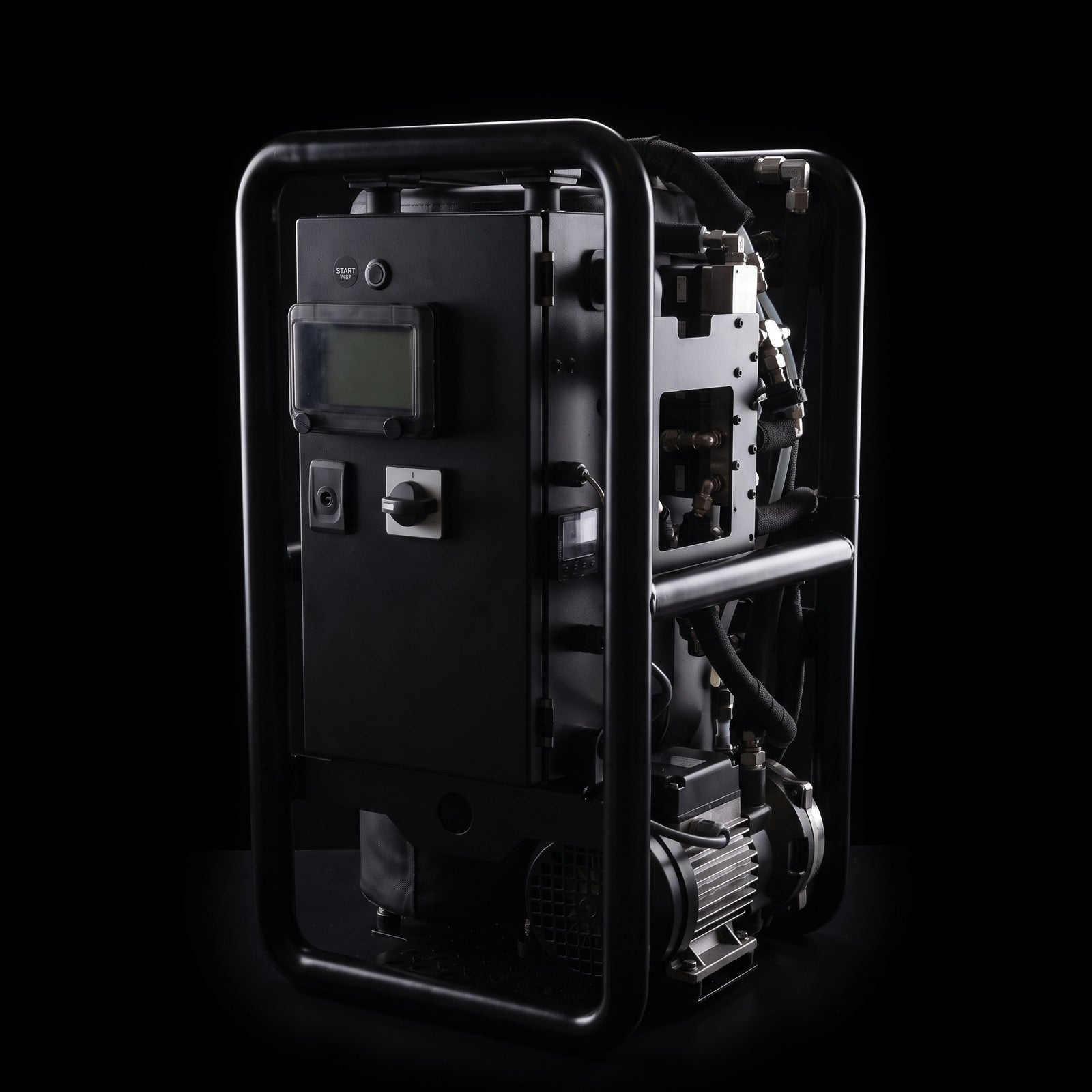

Safe drinking water from unknown sources.
The M1 is a miniaturised distillation plant two people can carry. No filters, membranes or chemicals. Nothing clogs, nothing runs out and purity doesn't drop over time.
- Plug-and-play installation, operational on site within 5 minutes
- Runs from 12/24 VDC, generators or 230 VAC
- Makes water as a background activity
Developed with funding and support from








“IF Defence has taken a technology already proven remotely and in the UK's NHS, and worked directly with MoD innovators and operators to evolve it for military use.”
Chester Butterworth
Head of Strategy, Disruptive Capabilities and Technologies Office (DCTO)
“The way CF works doesn't lend itself to ‘Big Army’ water purification solutions. CF ranks haven't got the capability to produce water and be mobile at the same time.”
UK Commando Forces
April 2026
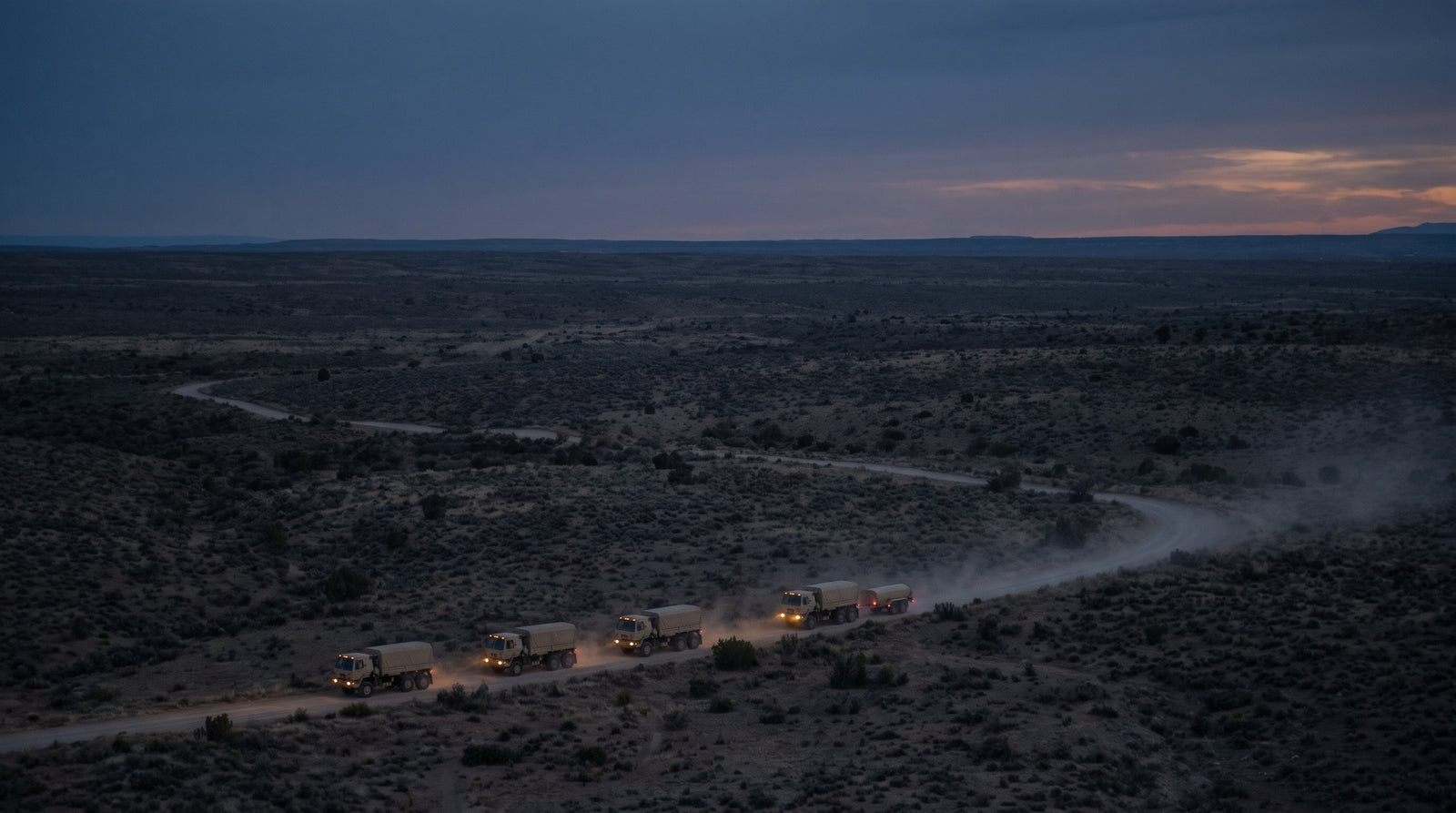

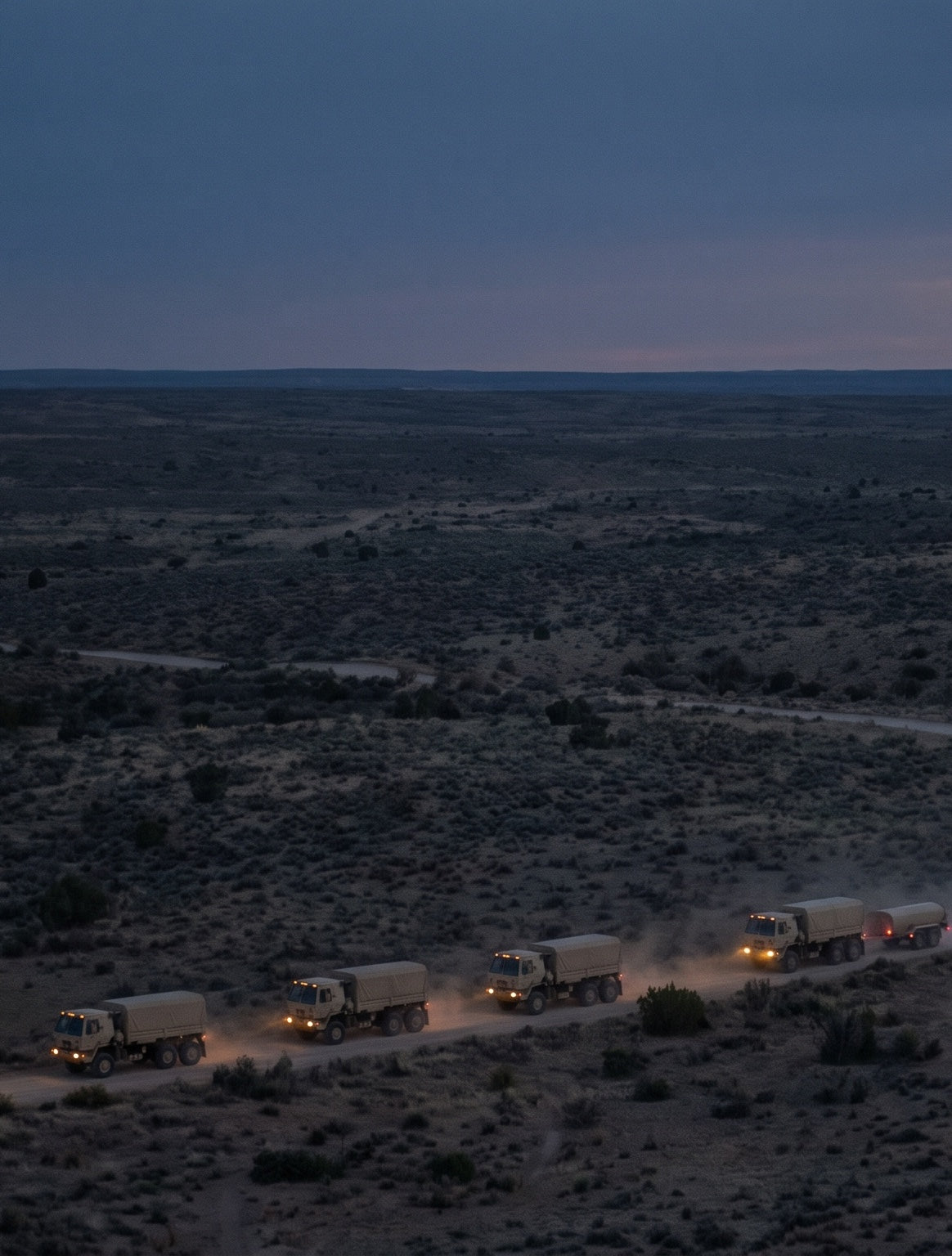

Every resupply is a signature
Water is the heaviest and most frequent resupply.
Resupply gives positions away
Convoys, rendezvous and logistics patterns create signatures that expose teams and concealed positions.
Carried water is carried weight
320kg of water keeps a 12-person team going for about five days at 5L/person. Every kilo is another vital supply left behind.
Purifiers that clog end missions early
Filters clog, membranes foul near the coast and consumables fail. Kit that fails on day three becomes one more thing to resupply.
Reliable water production as a background activity.
30+ days
Self-sufficient operations
Extend time between resupply beyond 7 days without carrying additional water.
<216
Litres / Day
Produces water at between 7-9L/h producing more than is needed in most applications.
12–16
Personnel supported
One M1 keeps a 12–16 person team in water: 168–216 litres a day.
40 kg
Two-person lift
Vehicle-mounted or man-portable, so it moves with the team.
ZERO
Consumable parts
Increasing reliability, and reducing operational expense and resupply pressure.
1 : 20
Diesel:Water
One litre of diesel produces 20 litres of water (depending on vehicle or generator efficiency)
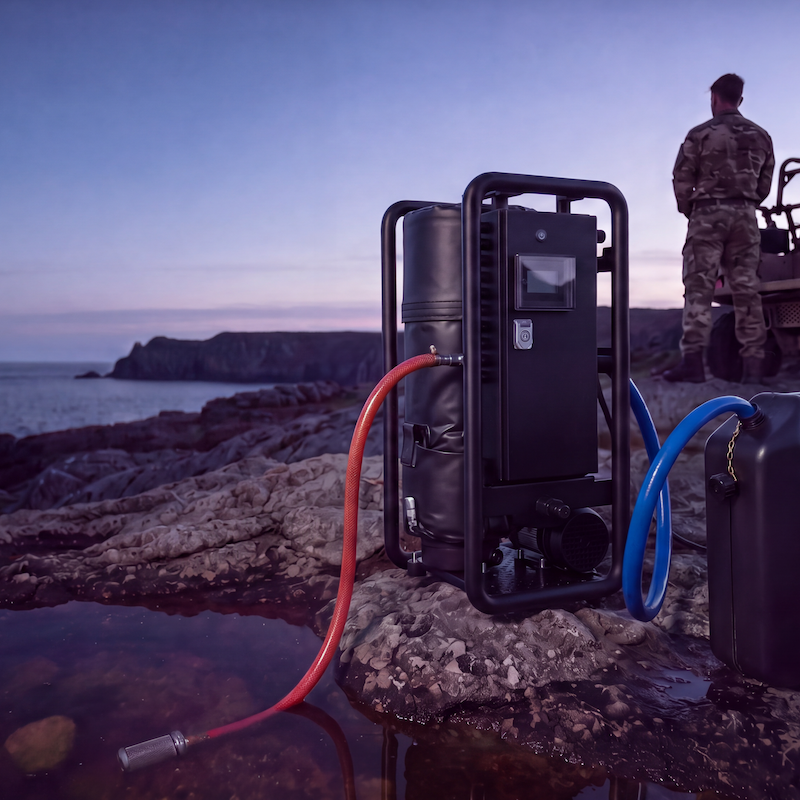

Coastal and variable water capable.
Works on seawater and coastal sources where RO membranes foul.


Lightweight, mobile and agile.
Vehicle-mounted or man-portable, UPS powered, moves with you instead of anchoring you.
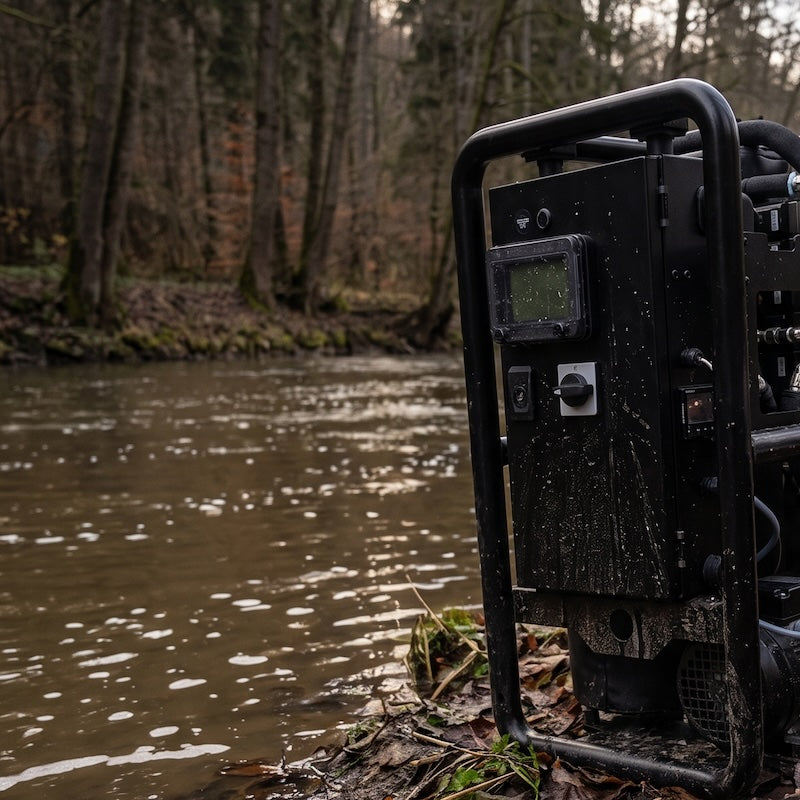

Purifies raw sources others can't.
Removes the contaminants that tablets and filters miss.
Send us your scenario: team size, mission lengths and water sources. We'll provide a custom business case for your water self-sufficiency. No obligation.
Request a quote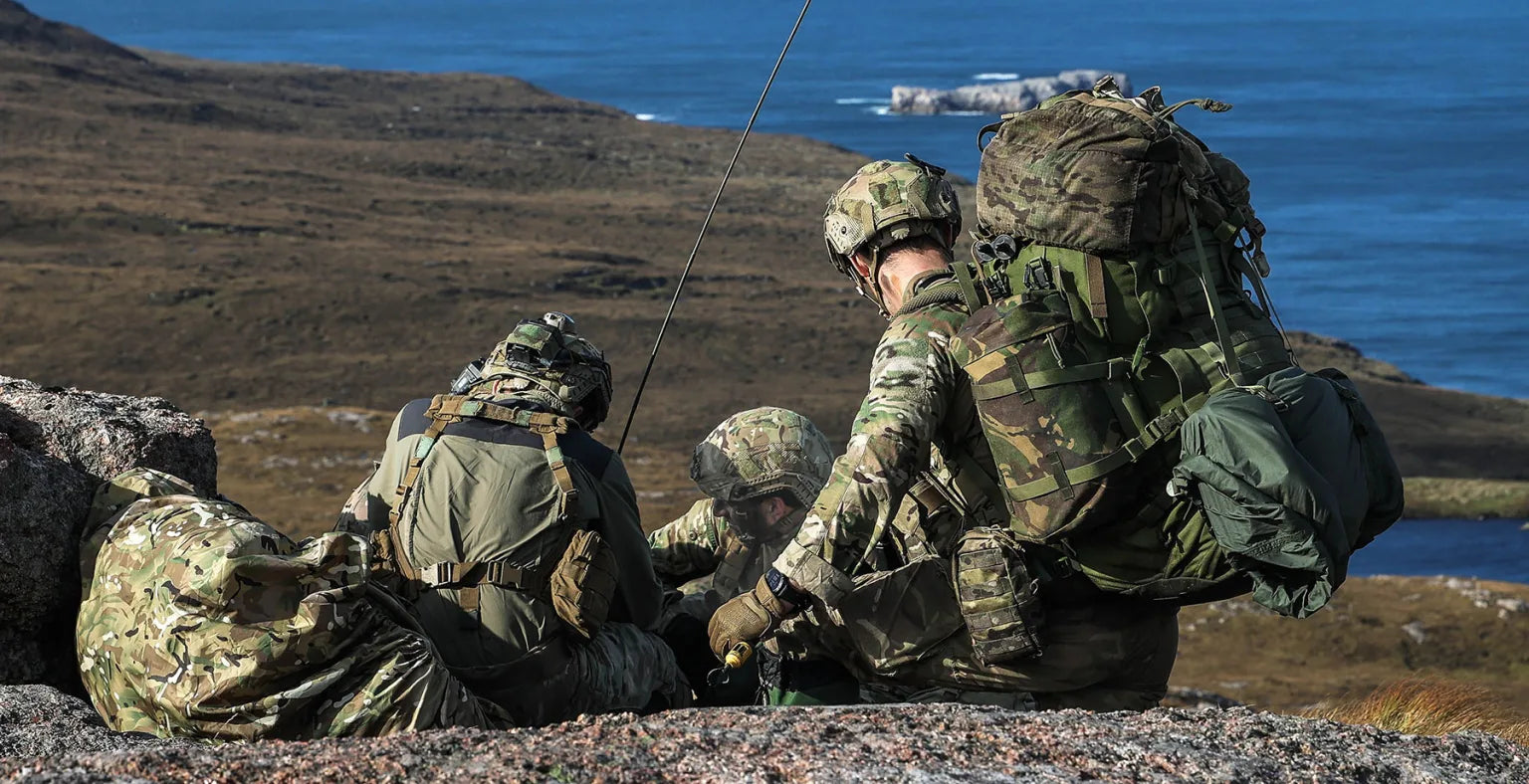

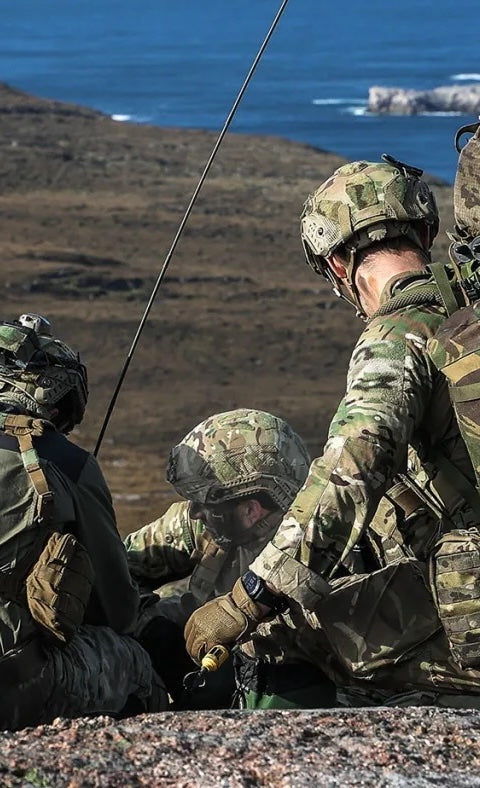

Developed with the MOD.
Proven on Exercise with UK Commando Forces.
Photo: © Crown copyright
One unit. Three missions.


Tactical
Go further, stay longer, be harder to find.
- Full jerry cans without resupply: water produced without convoys, rendezvous or logistics patterns.
- Silent, continuous operation: runs in the background with zero operator tasking.
- Source-agnostic, indefinite operation: seawater, rivers or taps.
- No consumables, no ops maintenance: no filters, membranes or chemicals to resupply.


Medical
Stay hidden and treat patients for longer.
- Eliminates water resupply and logistics signatures that expose concealed medical positions.
- Enables wound care, instrument washing, PPE hygiene and equipment cleaning.
- Designed to supply autoclave-ready distilled water for surgical and medical equipment.
- Rapid deployment (under 45 minutes) for critical use in challenging environments.


Disaster
Rapid water self-sufficiency response worldwide.
- Immediate hurricane response: drinking water on site within 30 minutes.
- No bottled water convoys: less delay, risk and logistics exposure.
- Works with available water from floods, rivers, seawater or damaged infrastructure.
- Deploy anywhere: vehicle-mounted or static; generator, solar or UPS powered.
M1 specifications
Performance
OutputUp to 9 L/hr
Daily output168–216 litres
ModesEco 7 L/hr
Boost 9 L/hr
ConsumablesNone
Dimensions
 650 mm
350 mm
Weight40 kg
CarryTwo-person lift
FootprintAbout two jerry cans
Height650 mm
Width350 mm
Depth350 mm
Water
Feed waterSeawater, rivers, stagnant water, floods and taps
Filters and membranesNone
Chemical dosingNone
FAQs
-
Yes. We demonstrate on your own water source, with your end users and decision makers together, and give you the results.
-
12/24 VDC, an inverter or 230 VAC. It draws 350 W steady and 1.1 kW at peak, and can run from vehicle platforms, a generator, solar or UPS. Energy demand is around 1 litre of diesel for every 20 litres of water.
-
Seawater, rivers, stagnant water, floods, taps and damaged infrastructure. Output meets WHO guidelines and the EU Drinking Water Directive (EU) 2020/2184.
-
Results are benchmarked against UK drinking water limits (PCVs), with an auditable record in your format.
-
The system can be set up in 5 minutes and starts producing water within 30 minutes of deployment.
-
None to resupply. There are no filters, membranes or chemicals, and no loss of purity over time.
-
They purify water in the same way. M1 Med adds a thermal disinfection capability and an additional frame with a stainless steel tank for water storage.
-
The M Range is modular. The M2 and M3 produce more water for field hospitals, FOBs and disaster relief, and add data logging on site.
-
It's a capital purchase. Request a quote with your team size and mission profile, and we'll send a written quote with lead time and delivery.
-
About 8p a litre in fuel, or 14–30p a litre including the M1 and its servicing over five years. For a 12-person team at 5 litres each a day (21,900 litres a year), that is about £3,000–£6,600 a year.
Fuel cost uses diesel at £1.50 a litre and a planning target of 20 litres of water per litre of diesel.


Your mission shouldn't end when the water does.
No obligation. We'll test it on your water, with your team.